BHD
BHD
 USD
USD
 SAR
SAR
 AED
AED
 OMR
OMR
 QAR
QAR
 KWD
KWD
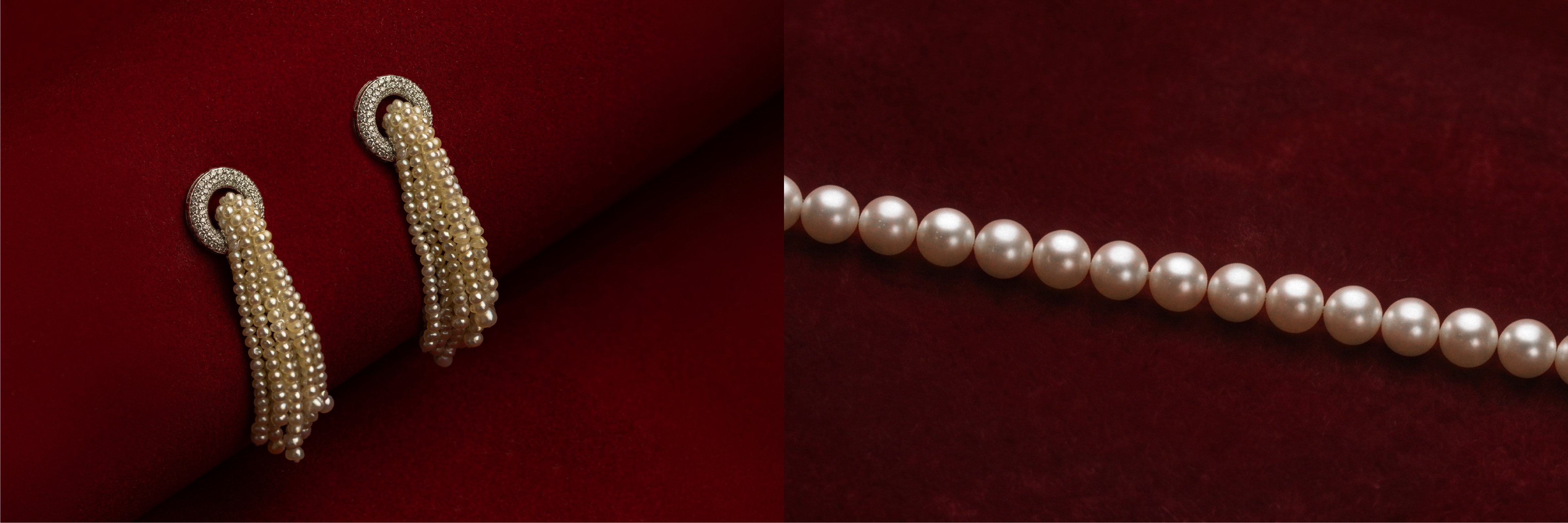
If you have ever shopped for pearl jewellery in Bahrain and come across the terms "natural" and "cultured," you have probably wondered which one you should actually be buying. Some people assume cultured pearls are fake, while others aren't sure if the difference even matters. Neither assumption is quite right, and understanding the real distinction can completely change how you shop for pearls.
This guide breaks down exactly how each type forms, what genuinely separates them in terms of value and appearance, and why the answer matters more in Bahrain than almost anywhere else in the world.
How Each Type of Pearl Actually Forms
Natural Pearls: Formed by Chance
Natural pearls form when a tiny irritant, such as a grain of sand or a small parasite, accidentally enters an oyster's soft tissue. To protect itself, the oyster coats the irritant in layers of nacre, the same smooth, iridescent material that lines the inside of its shell. Over several years, those layers build up slowly until a pearl forms.
The entire process happens by chance, with no human involvement at any stage. Divers search the seabed and open oysters with no guarantee of finding anything at all, which is exactly why natural pearls are so rare. Some estimates suggest only a small fraction of wild oysters ever produce a pearl worth using in jewellery.
Cultured Pearls: Formed with Human Assistance
Cultured pearls form through the same biological process, but with one key difference: a pearl farmer manually inserts a small nucleus or piece of tissue into the oyster to intentionally trigger nacre production. From that point forward, nature takes over in exactly the same way it does with natural pearls, and the oyster spends months or years coating the nucleus in layers of nacre.
Because the process is intentional rather than accidental, cultured pearls can be produced far more consistently, which is why they make up the vast majority of pearl jewellery sold worldwide today.
Are Cultured Pearls "Real" Pearls?
This is where most of the confusion comes from. Cultured pearls are absolutely real pearls, made of the same nacre, formed inside the same kind of living oyster, and just as genuine as natural ones. The difference lies entirely in how the process began, not in what the final pearl is made of.
A simple way to think about it: farmed fish and wild-caught fish are both real fish, just raised under different conditions. The same logic applies here. Cultured pearls are not imitation or fake, they are simply pearls that had some help getting started.
Key Differences That Actually Affect Value
Rarity and Availability
This is the single biggest factor separating the two. Natural pearls are extremely rare, since their formation relies entirely on chance. Cultured pearls, while still genuine and still valuable, are far more available because farmers can produce them in far greater numbers under controlled conditions. That difference in scarcity is the main reason natural pearls typically command significantly higher prices.
Shape and Size
Natural pearls tend to be more irregular in shape, since nothing about their formation is controlled. Baroque, asymmetrical shapes are common, and perfectly round natural pearls are considered exceptionally rare. Cultured pearls, on the other hand, are often rounder and more uniform, largely because the inserted nucleus is typically shaped to encourage a more symmetrical result.
Luster and Color
Natural pearls often carry a deeper, slightly more subtle luster, along with warmer undertones like cream or soft champagne. Cultured pearls can have a higher-gloss shine, though the exact look depends heavily on the type of mollusk and where it was farmed. Neither is inherently "better" in appearance, it largely comes down to personal preference.
How to Tell Natural and Cultured Pearls Apart
Honestly, telling the two apart with the naked eye is difficult, even for experienced buyers. A few simple checks can offer clues, though none are completely foolproof on their own.
Weight can be one indicator, since natural pearls are often slightly denser due to their fully organic formation. Surface irregularities, like small bumps or subtle asymmetry, can also hint at a natural origin, since cultured pearls tend to look more uniform. The classic tooth test, gently rubbing a pearl against your front tooth to feel for a slightly gritty texture, works for both natural and cultured pearls, so it only helps rule out obvious fakes rather than distinguishing between the two genuine types.
For any purchase where the distinction genuinely matters to you, the only reliable method is an X-ray examination performed by a certified gemological lab, which can clearly show whether the nacre grew around an inserted nucleus or formed entirely on its own. For high-value purchases, it is always worth asking your jeweller for documentation confirming whether a piece is natural or cultured, rather than relying on appearance alone.
Why Bahrain's Natural Pearls Are Considered Different
Bahrain holds a unique position in the global pearl industry. Unlike most pearl-producing regions today, Bahrain does not permit pearl cultivation within its waters. Every pearl harvested here forms entirely without human intervention, making Bahraini pearls genuinely natural in a market where the vast majority of pearls sold worldwide are cultured.
This is a big part of why natural pearl jewellery from Bahrain holds such strong value and cultural significance. When you choose a piece of Bahrain pearl jewellery, you are choosing something formed the traditional way, through the same patient process that shaped the region's pearling history for generations.
Sourced with Integrity: Al Jiwan Jewellery's Promise
At Al Jiwan Jewellery, working exclusively with natural pearls isn't just a sourcing decision, it's a commitment to the same standards that have defined Bahrain's pearling legacy for generations. Every piece is chosen for its authenticity first, so customers never have to wonder what they are actually buying. Browsing our jewellery in Bahrain makes that commitment easy to see for yourself, and pieces from our Arabesque pearl jewellery collection show how naturally formed pearls can be styled in genuinely modern ways. Have a question about a specific piece? Call us at 32060020 or email info@aljiwanjewellery.com, and our team will help you shop with confidence.
Final Thoughts
Both natural and cultured pearls are genuine, beautiful, and worth owning, but they are not the same thing, and the difference is more than just technical trivia. Rarity, formation, and origin all shape what you're actually paying for, which makes understanding the distinction genuinely useful the next time you shop. If authenticity and rarity matter to you, exploring Bahrain pearl jewellery gives you access to pearls formed the way nature intended, with no shortcuts involved.
Frequently Asked Questions
Are cultured pearls fake?
No, cultured pearls are completely real. They are made of the same nacre and form inside the same type of oyster as natural pearls. The only difference is that a pearl farmer intentionally starts the process rather than it happening by chance in the wild.
Which pearls are more valuable, natural or cultured pearls?
Natural pearls are typically far more valuable due to their extreme rarity. Since their formation relies entirely on chance rather than controlled farming, finding one at all is uncommon, which drives prices significantly higher than cultured pearls of similar size and quality.
Are Bahraini pearls natural or cultured?
Bahraini pearls are natural. Bahrain does not permit pearl cultivation in its waters, meaning every pearl harvested there forms without any human intervention, making it one of the few remaining sources of genuinely natural pearls in the world.
Which type is better for everyday wear?
Both hold up well for everyday wear, though the right choice often comes down to budget and personal priorities. Cultured pearls offer more consistent shapes at a more accessible price point, while natural pearls carry rarity and heritage that many buyers consider worth the investment.